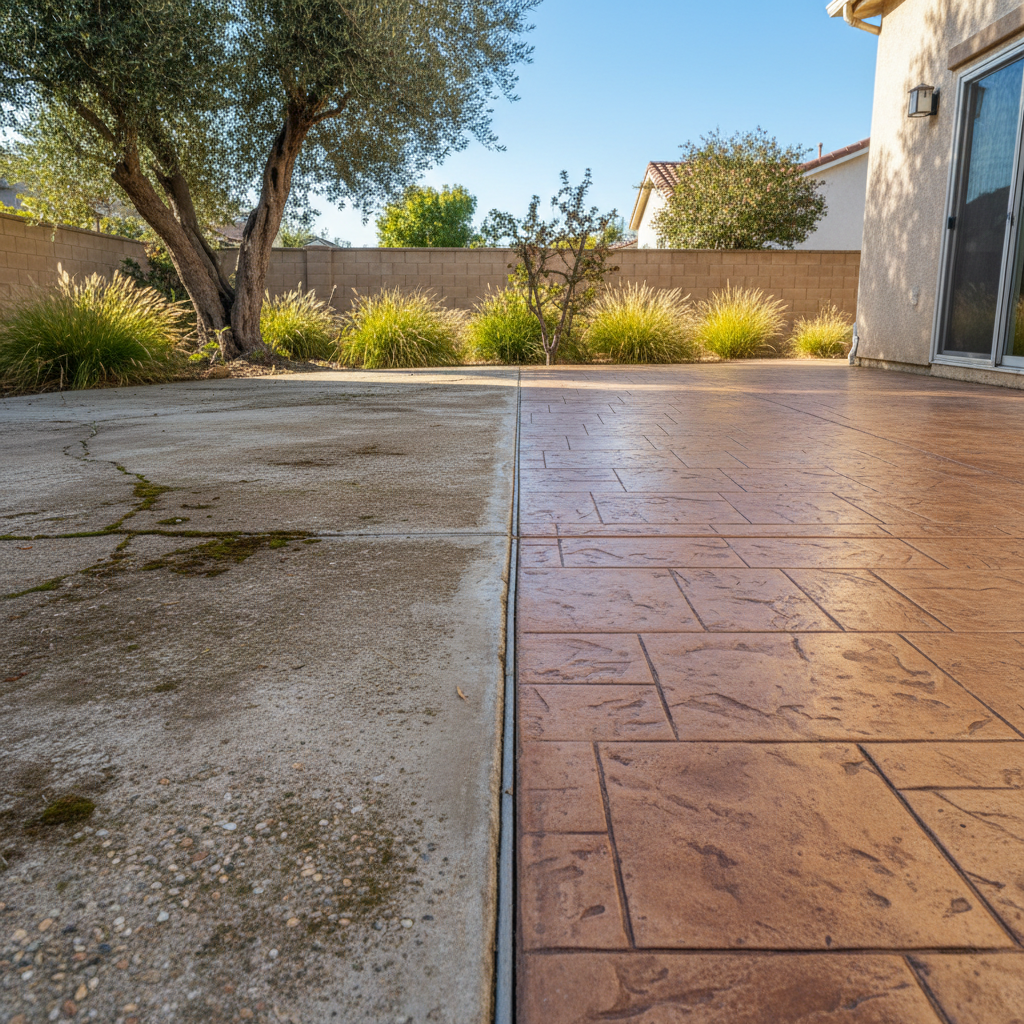
So, you're thinking about stamped concrete for your patio, walkway, or even your driveway right here in Tracy? Good call! It's a fantastic way to get that swanky look of stone, brick, or wood without all the fuss and expense of using the actual materials. But before you get too far down the road, you'll hit a crossroads: should you go with a stamped concrete overlay or just rip out the old stuff and pour a brand new slab?
That's a common question, and honestly, there isn't one "best" answer for every single situation. It really boils down to your existing concrete, what you're willing to spend, and what you're hoping to achieve. Let's break down the good and bad of each option.
Stamped Concrete Overlay: The Quick Refresh
An overlay is basically a thin layer of special concrete material that we put right over your existing concrete. Once it's down, we can stamp patterns into it and color it just like a regular slab. Think of it as a super heavy-duty resurfacing job, you know?
When an Overlay Makes Sense:
- Your existing concrete is in pretty good shape. This is the big one. An overlay isn't some kind of magic fix. If your current slab has big cracks, serious spalling (that's flaking, by the way), or is really uneven, an overlay won't solve those deeper problems. It'll just crack right along with the old concrete underneath. We're talking minor surface flaws here, maybe some small hairline cracks that we can prep and patch up.
- You're watching your budget. Generally, an overlay costs less than a full tear-out and replacement. You save money on demolition, hauling away debris, and all the labor involved in pouring a thick new slab.
- You need it done faster. Without the demo and all that extensive sub-base prep, an overlay project can often wrap up quicker than a new pour.
Where Overlays Might Not Be Enough:
- Durability concerns. While today's overlay products are tough, they're just not as strong as a full, thick concrete slab. They're usually only 1/4 to 1/2 inch thick. Heavy vehicles, like a big truck pulling into a driveway, could be a risk over time, especially if the bond isn't perfect.
- Limited problem solving. Like I said, an overlay won't fix structural issues. If your slab is sinking because of poorly compacted soil—something we see in some of the older parts of Tracy with our expansive clay soils—an overlay is, well, just covering up the real problem.
- Lifespan. A well-installed overlay can last a good 10-15 years, sometimes even more, but it's probably not going to hit the 20-30+ year lifespan of a properly installed new concrete slab.
New Stamped Concrete Slab: The Best Option
This is the classic approach: we tear out your old concrete, get the sub-base ready (that means compacting the soil, laying gravel), put in rebar or mesh, and then pour a brand new, full-thickness concrete slab that we stamp and color.
When a New Pour is Your Smartest Move:
- Your existing concrete is totally shot. If you've got huge cracks, uneven sections, major spalling, or drainage problems, a new pour is the only real answer. Don't throw good money after bad trying to fix something that's already failing.
- Maximum durability and longevity. A new, properly installed 4-inch (or thicker for driveways) concrete slab with reinforcement is built to last. It's going to stand up to heavy use and our local weather for decades, no problem.
- Complete design freedom. With a fresh start, you get total control over the grade, how water drains, and the whole layout. You're not stuck with the footprint or condition of the old concrete.
- Adding new space. If you're making your patio bigger or building a whole new area, a new pour is obviously the way to go.
The Downsides of a New Pour:
- Higher cost. Demolition, hauling, more material, and more labor all add up. It's a bigger upfront investment, for sure.
- More disruptive. Tearing out concrete is loud and messy. The project will generally take longer from start to finish, too.
My Recommendation for Tracy Homeowners
Look, I'm always going to push for doing things right the first time. For most homeowners here in Tracy, especially for spots like driveways or main patios that see a lot of foot traffic or even vehicles, a new stamped concrete pour is almost always the better long-term investment.
Why? Because of our climate and soil conditions. We get scorching summers that can bake the ground, and then we get winter rains. This constant expansion and contraction, especially with our clay-heavy soils, really stresses concrete. A full, reinforced slab is just going to handle those stresses better and last longer.
An overlay can be a decent option for a secondary patio, a small walkway, or if your existing concrete is genuinely in excellent, stable condition and you're just looking for a cosmetic update on a tighter budget. But even then, I'd want to inspect it myself, just to make sure it's a viable candidate.
At Apex Concrete, we've done both kinds of jobs, and we've seen how they hold up over the years. We're always happy to come out, take a look at your specific situation, and give you an honest assessment of what we think will work best for your home and your wallet. Don't hesitate to give us a call.